

Tienen. The Grote Gete valley
project: English, pll_6ad9b1b3ae07f, reforestation
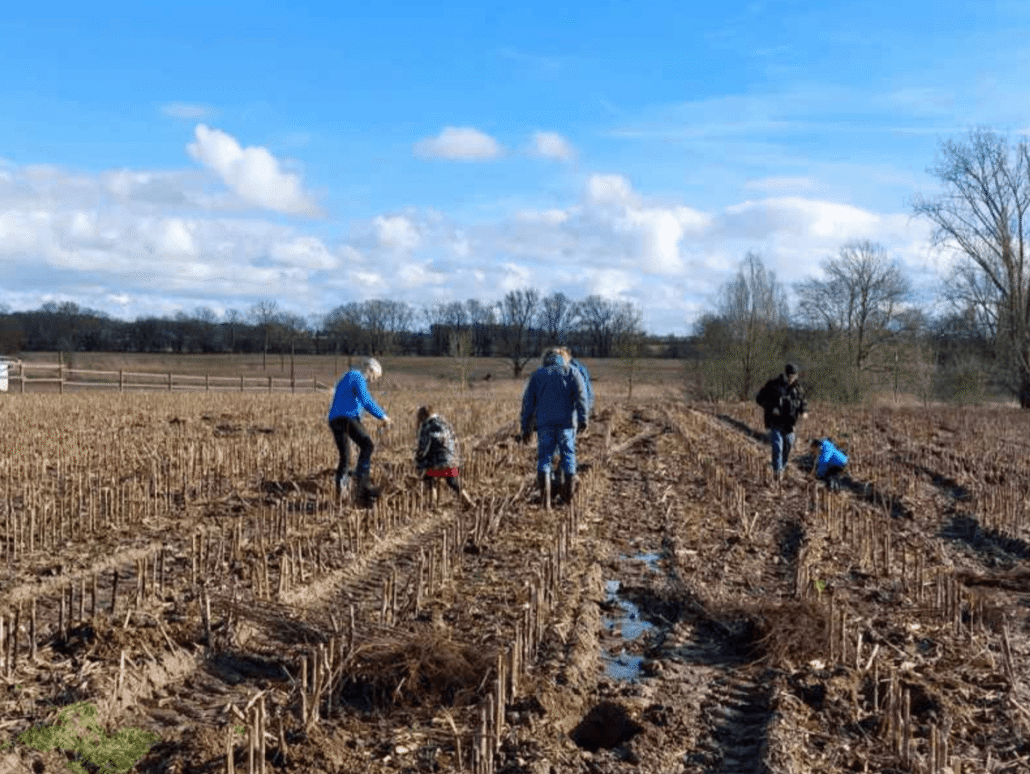
On a former maize field in Tienen, in the Grote Gete valley, around fifty volunteers planted 3,600 trees and shrubs in a single day. With more than ten native species, this 3.59-hectare site marks the beginning of a biodiverse woodland. In the centre, canopy trees were planted in small clusters, while rows of shrubs and smaller trees were planted around the perimeter, mirroring the structure of a natural woodland edge. Natuurpunt’s field team had pre-drilled the planting holes, as the wet, loamy soils of the Leemstreek region made for demanding work.
This new woodland is part of a wider landscape. It adjoins the Spoorwegzate Tienen-Hoegaarden nature reserve, a former railway line that connected Tienen with Ramillies via Hoegaarden and Jodoigne, and saw its last train in 1968. Since then, its embankments have developed into a green tunnel of native species (goat willow, hawthorn, hazel, hornbeam and spindle) with traveller’s joy climbing more than ten metres high. In the surrounding meadows, you can still recognise the pattern of ditches recorded on maps commissioned by the Austrian Count de Ferraris around 1776. Adding woodland here makes an existing landscape both larger and more resilient, with more core habitat, more shelter and greater connectivity between species. That is needed, because Flanders has a woodland deficit to address. Through initiatives such as Meer bos voor Vlaanderen (“More Woodland for Flanders”), the region aims to create 10,000 hectares of additional woodland by 2030, and this plot is a tangible contribution to that ambition. Over the coming winters, Natuurpunt Velpe-Mene will plant a further nineteen hectares of woodland in the Tienen, Hoegaarden, Boutersem and Bierbeek area. Every plot planted today is a place where carbon will still be stored in the soil and wood a hundred years from now.
The calculation follows Claire’s ISO 14064 methodology for afforestation. The project boundary is the area actually planted: 3.59 hectares, with 3,600 trees and shrubs representing more than ten native species. For this planting, Claire applies an annual carbon sequestration rate of approximately 7 tonnes of CO₂ per hectare. This amounts to 25 tonnes of CO₂ removed from the atmosphere and stored in wood and soil each year. Over the three-year period used by Claire, the total is 75 tonnes of CO₂. As with all our projects, the figures are externally validated in accordance with ISO 14064 and reviewed by our scientific council.
Location: Tienen
Availability: 75 tonnes of CO₂
Contact: christoph@claire-co2.com
